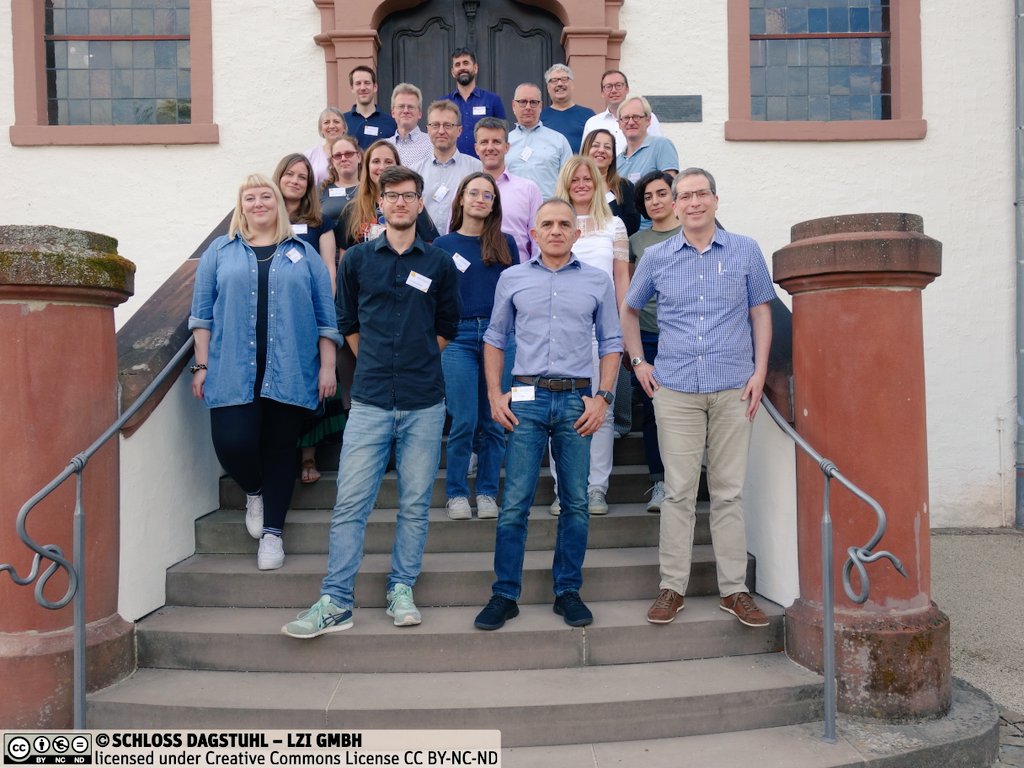
For five days, scholars in computer science, political science, law, and communication sciences discussed current challenges and future opportunities of online participation, political communication, and online deliberation.
29. September 2022 |
cristina_sarasua |
Comments Off on Major Congratulations, Dr. Baumgartner!
On August 30, our colleague Matthias Baumgartner defended his PhD Thesis “How to Compare Apples to Oranges: Integrating Heterogeneous Data Sources with Representation Learning” supervised by Prof. Abraham Bernstein.
We wish Matthias all the best in his future endeavors!
9. August 2022 |
cristina_sarasua |
Comments Off on New Article by Baumgartner et al. at the Journal of Web Semantics
Congratulations to our colleagues Matthias Baumgartner, former DDIS PostDoc Daniele Dell’Aglio, Heiko Paulheim (University of Mannheim), and Abraham Bernstein on their new journal article “Towards the Web of Embeddings: Integrating multiple knowledge graph embedding spaces with FedCoder” at the Journal of Web Semantics!
Abstract: The Semantic Web is distributed yet interoperable: Distributed since resources are created and published by a variety of producers, tailored to their specific needs and knowledge; Interoperable as entities are linked across resources, allowing to use resources from different providers in concord. Complementary to the explicit usage of Semantic Web resources, embedding methods made them applicable to machine learning tasks. Subsequently, embedding models for numerous tasks and structures have been developed, and embedding spaces for various resources have been published. The ecosystem of embedding spaces is distributed but not interoperable: Entity embeddings are not readily comparable across different spaces. To parallel the Web of Data with a Web of Embeddings, we must thus integrate available embedding spaces into a uniform space.
Current integration approaches are limited to two spaces and presume that both of them were embedded with the same method — both assumptions are unlikely to hold in the context of a Web of Embeddings. In this paper, we present FedCoder— an approach that integrates multiple embedding spaces via a latent space. We assert that linked entities have a similar representation in the latent space so that entities become comparable across embedding spaces. FedCoder employs an autoencoder to learn this latent space from linked as well as non-linked entities.
Our experiments show that FedCoder substantially outperforms state-of-the-art approaches when faced with different embedding models, that it scales better than previous methods in the number of embedding spaces, and that it improves with more graphs being integrated whilst performing comparably with current approaches that assumed joint learning of the embeddings and were, usually, limited to two sources. Our results demonstrate that FedCoder is well adapted to integrate the distributed, diverse, and large ecosystem of embeddings spaces into an interoperable Web of Embeddings.
2. May 2022 |
Abraham Bernstein |
Comments Off on Paper “Capable but Amoral? Comparing AI and Human Expert Collaboration in Ethical Decision Making” wins Honorable Mention at CHI 2022
The paper, which looks into how the kind of expert giving the advice — i.e., a human or an AI advisor — influences trust, perceived responsibility, and reliance.
For your convenience you can also find the abstract right here:
While artificial intelligence (AI) is increasingly applied for decision-making processes, ethical decisions pose challenges for AI applications. Given that humans cannot always agree on the right thing to do, how would ethical decision-making by AI systems be perceived and how would responsibility be ascribed in human-AI collaboration? In this study, we investigate how the expert type (human vs. AI) and level of expert autonomy (adviser vs. decider) influence trust, perceived responsibility, and reliance. We find that participants consider humans to be more morally trustworthy but less capable than their AI equivalent. This shows in participants’ reliance on AI: AI recommendations and decisions are accepted more often than the human expert’s. However, AI team experts are perceived to be less responsible than humans, while programmers and sellers of AI systems are deemed partially responsible instead.
7. April 2022 |
cristina_sarasua |
Comments Off on New Paper on Recommender Systems by Klinger et al.
Congratulations to Yasamin Klinger (former guest member of DDIS working at ZHAW) and colleagues for their paper at EDBT 2022!
“Evaluation of Algorithms for Interaction-SparseRecommendations: Neural Networks don’t Always Win“
Authors: Yasamin Klingler, Claude Lehmann, João Pedro Monteiro, Carlo Saladin, Abraham Bernstein, Kurt Stockinger
Abstract: “In recent years, top-K recommender systems with implicit feedback data gained interest in many real world business scenarios. In particular, neural networks have shown promising results on these tasks. However, while traditional recommender systems are built on datasets with frequent user interactions, insurance recommenders often have access to a very limited amount of user interactions, as people only buy a few insurance products. In this paper, we shed new light on the problem of top-K recommendations for interaction-sparse recommender problems. In particular, we analyze six different recommender algorithms, namely a popularity-based baseline and compare it against two matrix factorization methods (SVD++, ALS), one neural network approach (JCA) and two combinations of neural network and factorization machine approaches (DeepFM, NeuFM). We evaluate these algorithms on six different interaction-sparse datasets and one dataset with a less sparse interaction pattern to elucidate the unique behavior of interaction-sparse datasets. In our experimental evaluation based on real-world insurance data, we demonstrate that DeepFM shows the best performance followed by JCA and SVD++, which indicates that neural network approaches are the dominant technologies. However, for the remaining five datasets we observe a different pattern. Overall, the matrix factorization method SVD++ is the winner. Surprisingly, the simple popularity-based approach comes out second followed by the neural network approach JCA. In summary, our experimental evaluation for interaction-sparse datasets demonstrates that in general matrix factorization methods outperform neural network approaches. As a consequence, traditional well-established methods should be part of the portfolio of algorithms to solve real-world interaction-sparse recommender problems.”
21. March 2022 |
cristina_sarasua |
Comments Off on Paper on Scene-Text Extraction in Video
In the context of his bachelor thesis, Alexander Theus developed a method for scene-text extraction in video called HyText, based on intermittent detection and bi-directional tracking. The method is able to match existing approaches in accuracy while being substantially faster. Alexander Theus, together with our colleagues Luca Rossetto (supervisor of the bachelor thesis) and Abraham Bernstein, has recently published a paper at the 28th International Conference on Multimedia Modeling (MMM 2022). Congratulations!
“HyText – A Scene-Text Extraction Method for Video Retrieval.“
Abstract: “Scene-text has been shown to be an effective query target for video retrieval applications in a known-item search context. While much progress has been made in scene-text extraction from individual pictures, the special case of video has so far received less attention. This paper introduces HyText, a scene-text extraction method for video with a focus on retrieval applications. HyText uses intermittent scene-text detection in combination with bi-directional tracking in order to increase throughput without reducing detection accuracy.”
21. March 2022 |
cristina_sarasua |
Comments Off on Major Congratulations to Dr. Tolmeijer!
On February 24, our colleague Suzanne Tolmeijer defended her PhD Thesis “The Right Thing To Do? Artificial Intelligence for Ethical Decision Making” supervised by Prof. Abraham Bernstein.
Looking like a cyborg at my PhD defense, very fitting 🤖 I successfully defended my thesis 'The Right Thing To Do? Artificial Intelligence For Ethical Decision Making', summa cum laude y'all 🤩🤯 glad it could be in person, time for a well-deserved break #phdone#phinished [1/3] pic.twitter.com/fwZGINTbdi
While we are sad to see her leave our group, we are extremely happy for her and wish her all the best in her new endeavors! Suzanne will join the University of Hamburg as a postdoc in the group of Prof. Eva Bittner.
21. March 2022 |
cristina_sarasua |
Comments Off on Two New Publications by Heitz et al.
Congratulations to our colleague Lucien Heitz on publishing two new publications!
The first publication is a journal article published in the distinguished Digital Journalism journal. Written as a collaboration between computer science and communication science scholars, the article studies the effects of diverse news recommender systems in the context of democracy.
“Benefits of Diverse News Recommendations for Democracy: A User Study“
Authors: Lucien Heitz, Juliane A. Lischka, Alena Birrer, Bibek Paudel (former DDIS member, currently at Stanford University), Suzanne Tolmeijer (former DDIS member, soon at the University of Hamburg), Laura Laugwitz, and Abraham Bernstein
Abstract: “News recommender systems provide a technological architecture that helps shaping public discourse. Following a normative approach to news recommender system design, we test utility and external effects of a diversity-aware news recommender algorithm. In an experimental study using a custom-built news app, we show that diversity-optimized recommendations (1) perform similar to methods optimizing for user preferences regarding user utility, (2) that diverse news recommendations are related to a higher tolerance for opposing views, especially for politically conservative users, and (3) that diverse news recommender systems may nudge users towards preferring news with differing or even opposing views. We conclude that diverse news recommendations can have a depolarizing capacity for democratic societies.”
The second publication is the book “Spotlight on Artificial Intelligence and Freedom of Expression: A Policy Manual“, co-authored by Eliska Pirkova, Matthias Kettemann, Marlena Wisniak, Martin Scheinin, Emmi Bevensee, Katie Pentney, Lorna Woods, Lucien Heitz, Bojana Kostic, Krisztina Rozgonyi, Holli Sargeant, Julia Haas, and Vladan Joler. You can read the full book here.
20. December 2021 |
cristina_sarasua |
Comments Off on Wrapping Up 2021 – A DDIS Year in Review
2021 was a year of resilience: we continued to live through the pandemic, but we were able to be very successful, despite all the challenges posed by long-lasting remote/hybrid work. We published our research in several top conferences and journals, we acquired new research funding, we attended online scientific events, one of our colleagues obtained her PhD, and a new member joined the group.
Staff Updates
We were sad to see our colleague Romana Pernisch leave DDIS, but it was for a very good reason: Romana Pernisch successfully defended her PhD thesis “Mind the Change, Bridge the Gap Investigating the Impact of Ontology Evolution on Materialisations and Embeddings” supervised by Prof. Bernstein. Romana is currently a postdoc at Vrije Universiteit (VU) Amsterdam. We wish her all the best!
We are very happy that Kathrin Wardatzky decided to join us in 2021 to pursue a PhD on explainable AI.
Research
Our research got published in a variety of venues resulting in a total of 20 publications:
Suzanne Tolmeijer, Lucien Heitz and Prof. Bernstein, together with external colleagues, published the Dagstuhl Manifesto “Diversity in News Recommendations“.
Martin Sterchi, Cristina Sarasua, Prof. Bernstein and other external colleagues published the journal article “Outbreak Detection for Temporal Contact Data” at the Applied Network Science Journal.
2021 was extremely successful in terms of funding acquisition:
Luca Rossetto received an SNSF Ambizione grant for the MediaGraph project.
Prof. Bernstein and collaborators received an SNSF Sinergia grant for the project Large-Scale Political Participation: Issue Identification, Deliberation, and Co-creation —a collaboration with Cristina Sarasua, UZH Prof. Marco Steenbergen and UZH Prof. Felix Uhlmann, as well as Prof. Gianluca Demartini from the University of Queensland (UQ).
Lucien Heitz and Prof. Bernstein received a BAKOM grant for a second round of the news experiment.
Rosni Vasu and her collaborators from Stanford and Cornell University received a Toloka research grant for crowdsourcing experiments.
Events
Networking and disseminating our work at scientific events is one of the most exciting activities for us, scientists. While in 2021 we continued to attend events mostly online due to the COVID-19 situation, we had the chance to participate in very interesting workshops and conferences:
We supervised three master projects, four bachelor theses, and 11 master theses.
In the area of news recommender systems: Valérie Nyffeler, Julian Croci, Madhav Sachdeva, Lukas Yu successfully completed their master project “Informfully Full Stack News App Extension” and Emanuel Graf, Vladimir Donkov completed their master project “Multimedia Extensions for Informfully” both supervised by Lucien Heitz. Nick Kipfer completed the bachelor thesis “Automatic Selection of Illustrative Pictures for News Articles” co-supervised by Lucien Heitz and Luca Rossetto. Marco Heiniger completed the bachelor thesis “Recommender System for Portfolio Management” supervised by Lucien Heitz. Lukas Yu and Lukas Grässle are working on their master theses “Style Transfer Algorithm for Online News” and “Recommender Systems” supervised by Lucien Heitz and plan to finish them in 2022.
In the area of multimedia understanding: Patrick Düggelin completed the master thesis “Voice isolation, speech transcription and speaker re-identification in video”, Alexander Theus completed the bachelor thesis “Scene Text Extraction for Retrieval of Visual Multimedia”, Amos Neculau completed the master thesis “Multi-Domain Media Segmentation”” Lawand Muhamad completed the master thesis “Approximate Boolean Retrieval”, Simon Widmer completed the master thesis “Large-scale Active Learning for Concept Detection in Video” —all supervised by Luca Rossetto. A paper based on the thesis by Alexander Theus has been recently accepted at MMM’22. Lutharsanen Kunam is planning to finish the master thesis “High Level Semantic Video Understanding” with Luca Rossetto in 2022.
In the context of the CrowdAlyticsproject: Joel Watter completed his bachelor thesis “The Argument Annotator Pipeline – Generate Visually Annotated Documents” supervised by Florian Ruosch. Ning Xie and Rinor Sefa are working on the “CrowdAlytics Annotation Framework” as a master project supervised by Cristina Sarasua, Florian Ruosch, Rosni Vasu, and Dhivyabharathi Ramasamy.
Moreover, Terézia Bucková completed her master thesis “Supervised and Unsupervised Alignment of Knowledge Graphs with pre-trained embeddings” supervised by Matthias Baumgartner and Daniele Dell’Aglio, and Badrie L. Persaud completed the master thesis “Human Perception of Privacy: Visualizing Epsilon for Differential Privacy” supervised by Narges Ashena. Vasiliki Arpatzoglou is working on the master thesis “Autonomous Car Acceptance” supervised by Suzanne Tolmeijer and Luca Rossetto, and Fan Feng is currently working on the master thesis “Natural Language Question Answering via Knowledge Graph Reasoning” supervised by Ruijie Wang.
Announcements
We have several open positions. If you are interested in pursuing a PhD and working with us, please have a look at the current job ads: https://www.ifi.uzh.ch/en/ddis/jobs.html
We look forward to the new colleagues, projects, experiments, and papers to come!